Blair's main theory, in my opinion, is that while visual arguments can exist, most of what we perceive as visually argumentative is just a visual statement. Blair also says that when visual arguments do exist they "are not distinct in essence from verbal arguments" (Blair, 362).
I agree with Blair on the latter point, that visual arguments are not by nature any different than verbal arguments (an argument is an argument); however I could not disagree with Blair more on the first point.
Blair is saying that visuals that are seen as argumentative are not arguments, because they are statements, regardless of tone or sub-tones. However, I'd refute that by saying that by presenting one, two, or three pointed statements using only visuals; you will have those that agree, those that disagree, and those that agree or disagree on individual parts. This also assumes that your reader (or viewer in the visual sense) has understood the original intention of your statement, and not come up with his or her own completely different argument. So the "statement" has presented "argument," regardless of whether or not the argument on either side is directly present or intended. In my opinion it’s nearly impossible to have one without the other.
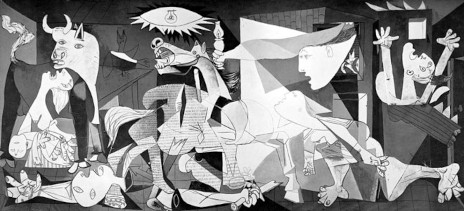
Blair uses the Picasso painting “Guernica” as an example and says that the painting states that “this was a terrible, cruel, and destructive act” (Blair, 350). To Nazi leadership and sympathizers, this was probably deemed a key military, psychological, and strategic movement. However dark and twisted the latter statement is, the painting only presents an image, the statement and argument both come from the reader.
It’s for these reasons that I think Blair is incorrect, you cannot have statement without the possibility of argument, and you cannot have an image that is statement free to everyone.
Blair, J. Anthony. Visual Rhetoric in a Digital World. Ed. Carolyn Handa. Boston: Bedford / St. Martin's, 2004. 344-363.


1 comment:
I really like you disagreeing with Blair. You have summarized a lot of my disagreement too.
I wonder though--is it worth it to have arguments=premise-->conclusion.
That way we can further distinguish visual images as POVs or persuasive.
Post a Comment