a. Capital letters have played a significant role in typography for a very long time. When scribes no longer were as needed and the printing press became more and more the way to do things, the illustrated letters began to take off rather rapidly. These oversized capital letters would draw the reader’s attention to the start of a page, a new chapter, and so on so that the reader knew a change had occurred within the type.
Capital letters today can do the same thing, especially in a non book sense. The examples Solomon uses in Visual Rhetoric in a Digital World, actually show that capitals can re-center a reader’s attention in the next or a different place in the text.
Also, in the same way we’ve become accompanied to a period ending a sentence, we’re programmed to see capitals at the start of one. This tells the audience that a new thought has begun.
b. Goffman’s theories are, for the most part, just as relevant as they were when this was published. In fact, Most of these advertising principles were around well before the ads Goffman presented.
Designer ring commercials these days will almost always use more than one of the principles Goffman talks about. A female will either present the ring, or she will receive it from a dominant male position. When she does receive it in the latter scenario, she will go ripe with emotion, showing both that she’s submissive to the gift recipient stereotype, and that you’ll have made her ecstatic by purchasing a certain brand.
Blair's main theory, in my opinion, is that while visual arguments can exist, most of what we perceive as visually argumentative is just a visual statement. Blair also says that when visual arguments do exist they "are not distinct in essence from verbal arguments" (Blair, 362).
I agree with Blair on the latter point, that visual arguments are not by nature any different than verbal arguments (an argument is an argument); however I could not disagree with Blair more on the first point.
Blair is saying that visuals that are seen as argumentative are not arguments, because they are statements, regardless of tone or sub-tones. However, I'd refute that by saying that by presenting one, two, or three pointed statements using only visuals; you will have those that agree, those that disagree, and those that agree or disagree on individual parts. This also assumes that your reader (or viewer in the visual sense) has understood the original intention of your statement, and not come up with his or her own completely different argument. So the "statement" has presented "argument," regardless of whether or not the argument on either side is directly present or intended. In my opinion it’s nearly impossible to have one without the other.
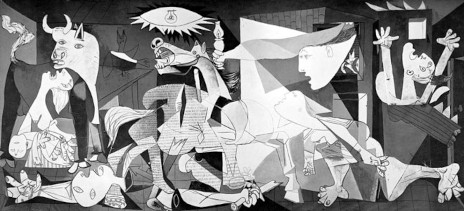
Blair uses the Picasso painting “Guernica” as an example and says that the painting states that “this was a terrible, cruel, and destructive act” (Blair, 350). To Nazi leadership and sympathizers, this was probably deemed a key military, psychological, and strategic movement. However dark and twisted the latter statement is, the painting only presents an image, the statement and argument both come from the reader.
It’s for these reasons that I think Blair is incorrect, you cannot have statement without the possibility of argument, and you cannot have an image that is statement free to everyone.
Random Google Image Search for the word of the day: Guernica
Cited: Blair, J. Anthony. Visual Rhetoric in a Digital World. Ed. Carolyn Handa. Boston: Bedford / St. Martin's, 2004. 344-363.
Back in the days when I was just a wee lad, I enjoyed spending time outside, preferably in some form of wilderness. My father was always an outdoor enthusiast, and so was his father. I pretty much enjoyed anything from hunting and fishing to four wheeling and snowmobiling, the nerd in me had yet to fully set in.
One summer the family decided to head out into the deep dark wilderness that is the Crystal Mountain ski resort. Ok, so it isn’t exactly the deep dark wilderness, but it did have a dark side we’d yet to fully encounter.
The way up to the mountain was like any other nice sunny summer day; nice, sunny, and summery. Birds chirped, bees buzzed, all the usual life that fills the Pacific Northwest forests in the middle of July. We were heading to the mountain to partake in an annual outdoors festival at Crystal Mountain. The main purpose of the week was a downhill mountain bike jam, however they opened all the other black diamond runs to joggers and hikers and various other flannel wearing western Washingtonians.
Basically the idea is this; the easier you make nature the more people you will attract. So Crystal turns on all the chair lifts and ships people to the top of the runs so they can hike joyfully down a dusty road that would be the grooming path during the winter. The hike down is not hard by any means, some of the runs are steep and the dirt can be somewhat slick, but anyone with better balance than an egg should have no issue.
That is until your father decides to take a short-cut through backcountry out of… to this day I’ve yet to determine why we ventured off the path. I think it had to do with slipping on the dirt, or general boredom fueled fighting between me and my brother. Either way, we cut through a pretty amazing meadow, all seemed well. I again had an onset of boredom however, and ventured off ahead.
I got to what was basically a cliff, but also a hill. I guess you could call it a very steep hill. Not steep enough for grass NOT to grow, but steep enough for it to not grow well. As I began to walk down, my speed increased considerably, gravity and all, until I was at a run.
At this point I’m fairly certain I’m doomed eventually, as I’m only half way down the steep face. Upon basically falling over a boulder, my fears confirmed themselves when face met ground. The tumbling that ensued would be admired by the most seasoned Olympic gymnasts. The dismount would have left room for improvement.
During one roll I saw a rock about 10 feet ahead of me. During another roll I smashed the top of my head into it. This repeated a few rolls later, when again, a rock was clearly visible in my path. Again the result was not in favor of my face. This one, and the general smoothing of the train, brought me to a stop. It took a few moments to realize what had really just happened, at which time I began to scream out of pain and anger … of falling down a mountain.
My parents got to the scene of my crash, we walked down to the next stage of the chair lift, where I was given an ice pack and had to sit as tens of onlookers stared in shock and asked pressing questions.
“Did you fall off the chair lift?”
“Oh my god what happened?”
“Does that hurt?!?” (No, the softball sized lumps on my face are totally in this year)
After a truck ride from mountain medical staff to the bottom of the hill, I was given a Popsicle and had to wait for my parents to get down to the medical center (which they actually had to open for me, apparently no one gets hurt in the summer). In the mean time, it turns out an onlooker called the news and reported that a child had fallen off the chair lift, and when they arrived we had to tell them they came out for nothing. That, and I was not going to give them permission to put my busted mug on television.
Two softball size lumps on my head and a minor concussion later I'd learned to not defy gravity, and that is why you don't ever go, or near, to Crystal Mountain.
Random Google Image Search for the word of the day: Goose Egg
(I went back once but that didn’t really count, I still hate that place)
On page one of Contemporary Perspectives on Rhetoric Foss notes that, for purposes of the book, "our definition of rhetoric features the use of symbols by humans" (Foss 1). To me this says that by creating, communicating, or expressing in any form a symbol, you're involved in rhetorical process. This brings up a whole slew of what-ifs however, as it is an extremely broad definition. For one, what if the presenter does not intend a symbol that an audience decides lies within the communication. In the opposite case, what if the audience doesn’t see a symbol the presenter was directly trying to imply. To me, both cases are still using rhetoric, but the end result could be different in both cases.
I use thousands of symbols every day, but to me in order for them to be perceived as rhetorical they have to imply something beyond the basic part of communication. As far as I understand, words within the English language would be symbols; when I add a large amount of sarcasm and undertone of implied meaning they become rhetorical. Rhetoric doesn’t have to have a negative connotation either, just something beyond what the normal symbol would be considered to an audience. At least that’s how I understand it, and would explain Foss’ definition.
The first Google result I chose to use was from the Merriam-Webster Online Dictionary, which states that rhetoric is "the art of speaking or writing effectively" (Merriam-Webster). To me that means simply communicating well. I don't think that's anything close to the definition of Rhetoric though, as discussed in class today. "Effectively" will differ from audience to audience, or even within the same group of listeners. You can still be communicating rhetorically and have some not understand, in my opinion.
The second Google result I chose to use was from the Stanford Encyclopedia of Philosophy, who notes that Aristotle's (of Greek fame) definition of a rhetorical person is a "rhetorician," that is "someone who is always able to see what is persuasive" (Stanford Encyclopedia of Philosophy). While this technically defines someone who practices rhetoric, I think the basis of the definition is more on point with my opinion of rhetoric. This would be communication with persuasion of some kind.
Random Google Image Search for the word of the day: Rhetoric